|
| menu | |
| search | |
| forums | |
| resources | |
| |
 | News: New research shows violence decreases under Nordic model: Why the radio silence? |
 published at Feminist Current January 22, 2013
You probably haven’t heard about the newest prostitution research from
Norway. It has been available in Norwegian since last summer when a tiny
handful of pro-prostitution peeps
wrote about it, but almost no one has noted the report’s English
release. Now that I’ve read it I understand the silence from pro-sex
work lobbyists and the liberal media that usually loves press releases
that hate on anti-pornstitution activists.
“Dangerous Liaisons: A report on the violence women in prostitution are exposed to” was presented to me as proof that criminalizing johns has increased violence against prostitutes in Oslo. Norwegian newspaper The Local reported on the research and dutifully presented the results highlighted by the harm reduction researchers at ProSentret.
“Anniken Hauglie (Conservative Party) called for the law
to be scrapped after the city’s official help centre for prostitutes,
ProSentret, released a report on Friday detailing deteriorating
conditions for sex workers in the capital.
‘The reality is that the law has made it more difficult for women in prostitution,’ Hauglie said.”
The 2012 research is compared to 2008 research and the conclusion
drawn is that in 2008 52% of prostitutes in Oslo said they had
experienced violence compared to 59% in 2012. An increase of 7% isn’t a
huge jump but any increase in violence against women should be taken
seriously.
Fortunately, the increase in violence against prostituted women is a lie.
LIARS!
Several obfuscations and omissions were employed to concoct the lie,
but the primary manipulation was accepting a definition of violence that
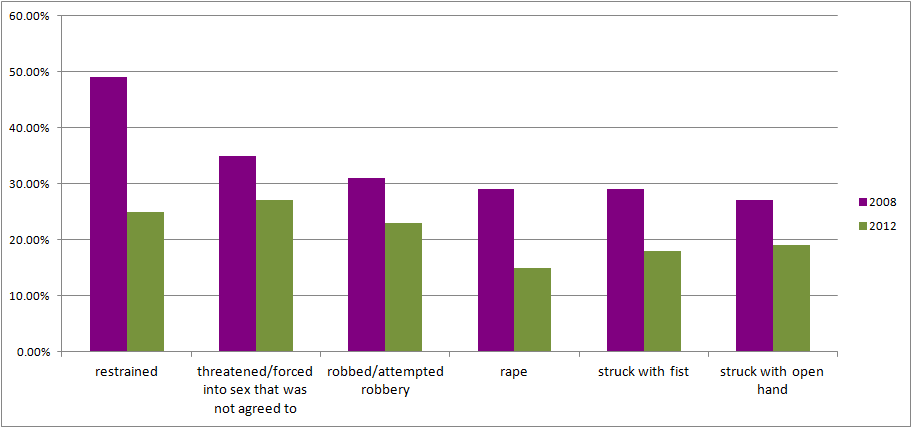
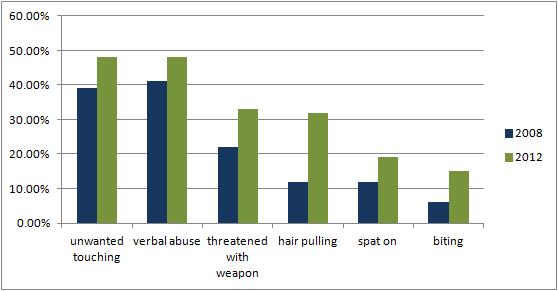
equated each act of verbal abuse (up 17% from 2008) and hair pulling
(up 167%) the same as being struck with a fist (down 38%) and rape (down
48%).
Did I just write that since the Nordic model rapes of prostituted women were down BY HALF in Oslo? Oh yes I did.
ProSentret did not consider the halving of rape to be worth pointing
out, but I think that’s terrific news. I also think that pimp violence
being down BY HALF since 2008 should be shouted from the rooftops along
with violence from regular clients going down 65% and violence from an
unfamiliar man in a car declining 60%.
Visible injury has decreased from a third of the sample to a fourth.
One thing that has changed is that the number that experienced
violence from someone unfamiliar in a car has declined from 27% to 11%.
We also see a decline in violence from regular clients from 20% to 7%, and 14% to 7% from boss/pimp.
With the dramatic reductions in serious violence within the research
you might be wondering from whence came the claimed 7% rise. The answer
is mostly verbal harassment and minor physical assaults because no
distinction is made between nasty words and being punched.
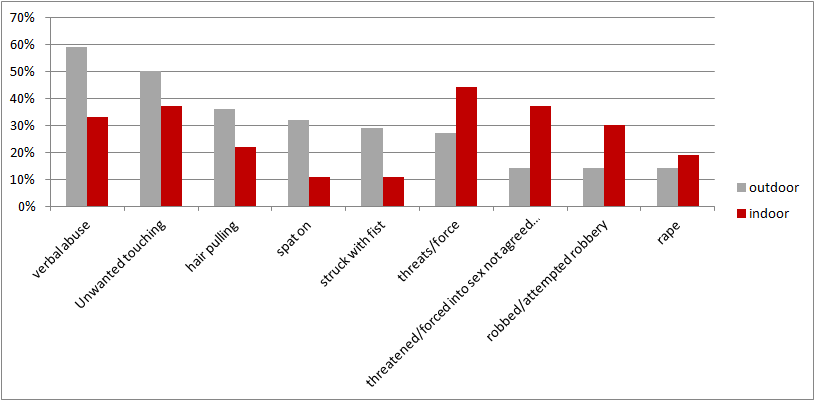
Harm reductionists love to thump about how indoor prostitution is
safer than streetwalking, and in some aspects it is, but the research
paints a contrary picture about indoor violence. Feminists have been on a
long mission to raise awareness that women are more often attacked in
their homes by men they know than in public by strange men. Why would
being in a brothel with a john suddenly become a place to expect less
rape when inside is never safer for women?
The research supports the known feminist truth of how women are
harmed when trapped indoors with men engorged on their perceived right
to control women. The most violent men are “unfamiliar clients” and the
women they inflict the worst sexual violence on are the indoor Thai
women, also the only group to report violence from pimps (11%).
In this group we find the largest amount of respondents
who say they have been threatened/forced into sex that was not agreed
to. While 27% of the entire sample said they had been exposed to this
form of violence, as many as 45% of this group have experienced it. In
this group we also see the highest amount of robbery (30%) and threats
with weapons (40%) Additionally 20% of this group said they had been
raped.
Indoor prostitutes are being sexually assaulted by their clients more
than streetwalkers, who are ultimately abused more frequently but not
raped or robbed more.
The information about indoor versus outdoor violence also disproves
the common refrain that because it’s now a “buyer’s market” prostituted
women are harmed by the lack of negotiation time. Streetwalkers mostly
suffer verbal abuse and minor physical assaults that aren’t violations
of sex act negotiations, whereas indoor prostitutes with the supposed
luxuries of pre-screening and unlimited time to negotiate are much less
capable of keeping their johns from robbing, raping, and
threatening/forcing them into sex that was not agreed upon.
Placing all the focus on how prostituted women negotiate distracts us
from questioning the varying motivations of negotiation-inducing men.
It is common sense that a man who wants a quick blowjob from a
streetwalker would be less invested financially and emotionally in his
sexual entitlement to a prostitute than a man who pre-arranges to pay
for an hour alone with a prostitute and brings a sixty minute gameplan
of fantasy fulfillment with him.
BITERS!
Allow me to turn your attention to some freaky shit you might have missed in the statistics tsumani above:
Biting nearly tripled (6% to 15%)
Hair pulling nearly tripled (12% to 32%)
I’ve lived in New York City and San Jose, Costa Rica, which is to say
I’ve been verbally harassed and suffered unwanted touching from
unfamiliar male passerby more times than I can count. Never have I been
bitten or had my hair pulled. That’s not passerby harasser behavior,
it’s john behavior. Information originally reported in the 2008 study
but repeated in the 2012 report provides a clue to why minor, sex
act-specific violence jumped.
“Most of the women who said they would seek help to
protect against violence said that they called or threatened to call the
police when they found themselves in a dangerous or threatening
situation. This would often scare the customers, or others, who were
acting threatening/violent away.”
Pro-prostitution lobbyists say men are paying for the right to sex
and not the right to abuse women. Johns don’t exhibit an understanding
of that difference, which is why letting men pay for sex and then trying
to draw a line at abuse is doomed to failure. Men paying for the right
to abuse women have crossed that line, no takesees-backsees halfway
through the series of abuses paid for, especially not when BDSM
inflicted on women is culturally approved as sex and not abuse.
Radical feminists know prostitution is coerced sex, aka rape. We
notice that most rape victims are teenage girls abused by older men and
recognize the same demographic patterns in prostitution. As with rape,
the sexual aspect of the crime triggers so many cultural prejudices that
the core of the crime being male violence is often left on the cutting
room floor. Oslo’s reduction in severe violence combined with the
increase in more personal boundary violence like biting and hair pulling
is a reminder that, as with other kinds of rape, sex is the preferred
tool of violation but violation itself is the main point.
Prostituted women in Oslo are effectively altering violent johns’
behaviors by threatening to call police, and johns are responding by
lowering their violence to under the threshold that would trigger that
response. Instead of rape and aggravated assault, johns have moved to
getting more of their violation kicks though biting and hair pulling
knowing these won’t result in a call to the cops.
On that note, let’s segue into what the report tells us about police and prostitutes.
COPPERS!
Police abuse of prostituted women is a problem. Some studies have found
that as much as 30% of violence against prostituted women can come from
police officers. Police abusiveness is frequently cited by harm
reductioners as a reason to legalize men’s prostitution use. ProSentret
makes a big deal of the fact that prostituted women are reporting less
violence because they claim it as a consequence of prostitutes trusting
police less, but it’s more accurately attributed to the large drop in
severe violence.
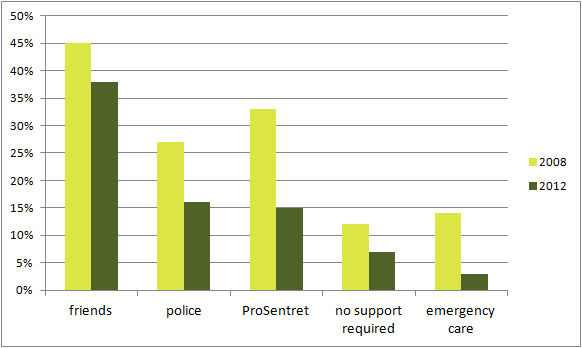
“If we look at assistance from police, emergency care,
Pro Sentret, and Nadheim, we see approximately half the number that
have received support in the 2012 study compared with the 2007/08
study.”
Approximately half the number receiving support matches up quite well
with rape being down by half and pimp violence being down by half.
According to their own numbers, since adoption of the Nordic model
prostitutes are 41% less likely to seek help from police, but they are
54% less likely to seek help from ProSentret! And apparently prostituted
women are suddenly terrified of emergency care personnel because
seeking help from them is down a whopping 79%.
If you don’t acknowledge the enormous reductions in severe violence
then these changes are as alarming as ProSentret makes them out to be.
Combined with street prostitution going down at least 50% from 2008 to 2009 and indoor prostitution going down by 16% in the same year, the sharp drop in prostituted women reporting violence is actually something to celebrate.
ProSentret’s ideological constipation won’t allow them to admit the enormous reduction in severe violence their data shows.
“Many of the women’s actions are probably due to a fear
of prejudice from the police, the justice system, and health services.
The double stigma as both victim of violence and prostitute can be a
heavy burden to bear. Other reasons could be among other things a lack
of knowledge of the police and reporting violence in Norway, fear that
the police will enforce other laws against the prostitute, a lack of
trust in the police, or that the women for some other reason does not
wish to press charges.”
Persons who make police abuse of sex workers their bailiwick may find
it instructional that none of the violence reported by the 123
prostituted women was pinned on Norwegian police, not so much as one
instance of verbal abuse. Score yet another point for the Nordic model.
Rarely does a group of pro-prostitution activists make their choice
to be ignorant so evident as to ignore the data from their own research.
Mind you, it’s not unheard of; New Zealand research collected by the
prostitution lobby claimed no changes to street prostitution in their
official summary but buried in Section 8 one finds the truth that street prostitutes in Auckland more than doubled since legalization.
It is a bald lie to take the information presented in “Dangerous Liaisons” and come to this conclusion:
“Nothing in the studies we have conducted among the women
and the support services suggests that the criminalization of the
customers have protected the women from violence from their customers,
rather the women are protecting the customers from the police.”
ENDERS!
The final words of the report declare:
This will be done by the Pro Sentret:
• Organize drop-in courses about violence in prostitution and
violence in close relations with a focus on knowledge about violence,
practical tips and information about offers of aid. The courses will be
organized in cooperation with Oslo Crisis Center and a provider of
self-defense courses.
• Work out and distribute information material adapted to the users
of Pro Sentret about violence, rights, and tips about maintaining their
own safety.
In other words, ProSentret’s goal is to build better hookers. I prefer other solutions.
The Nordic model works and should keep on keeping on. If ProSentret
and other sex worker rights groups refuse to get on board the abolition
of sex-based slavery they’re fools, but they’re fools who can still be
doing more for prostituted women from within their belief system.
The first thing they can do is actively track prostitution clients
more effectively. Unfamiliar clients commit the most violence and
passively relying on bad date reports from survivors of john violence is
not enough. There’s room for both police and nonprofits to be
collecting information about unfamiliar johns in their own way.
Next they can work to achieve reliable amnesty for foreign victims. I
am unfamiliar with how Norway treats trafficked immigrants but I have
no trouble believing more can be done to protect them from
discrimination and deportation.
My third and final suggestion is for harm reduction organizations to teach prostituted women that any
violence inflicted on them matters. Biting and hair pulling have almost
tripled but reporting them hasn’t. Johns will be as violent as they can
get away with so we need to keep pushing back the bar of acceptability.
Credit where due, the researchers sincerely attempted to honor
prostituted women’s psychological defenses by distinguishing the
categories of “rape” and “threatened/forced into sex that was not agreed
upon” in recognition that many don’t call it rape if there’s no assault
accompanying the sexual violence. They include this comment about
cultural differences in defining violence.
“Pro Sentret have experienced that in general many
foreign women express both physical and psychological pain differently
than Norwegian women. It is possible that some did not recognize their
way to express pain in the options in the study.”
It’s obvious the researchers at ProSentret care about the women they
serve, I just wish they could project that concern to the millions of
women they will never see and the generations of prostitutes that will
come after the current one if we don’t take a stand now.
Like I said in the beginning, the Oslo research has barely made a
blip in pro-prostitution media channels. The usual loudmouthed
prostitution lobbyists have seen it and kept their lips zipped. You
better believe if the report contained solid proof that the Nordic model
leads to more violence then it would be as popularized as that bunk
study purporting career pornstitutes are happier than the average woman.
Now you know about it, and now you know why the prostitution lobby
prefers to pretend it doesn’t exist.
It exists and it proves abolitionists right. Now don’t let them forget it.
|
|
|
Posted by smberg on Wednesday, June 12 @ 13:19:54 EDT (4411 reads)
Read More... | News | Score: 0
|
|
|
| News: A Crime That Should Shame Us All |
A Crime That Should Shame Us All
Eighty percent of trafficking victims are sold for sex.
February 25, 2009
By Swanee Hunt
In the midst of the bitter winter of a failing global economy, the
United Nations is calling the world's citizens to recognize the plight
of the most vulnerable: slaves.
It's
fitting that on the birthday of Abraham Lincoln, the Great Emancipator,
the UN Office on Drugs and Crime (UNODC) launched its first assessment
of the scope of human trafficking, the modern-day form of slavery.
The
findings are grim. Based on data from 155 states, the "Global Report on
Trafficking in Persons" includes country-specific information on
legislation and criminal-justice responses to global patterns and
criminal network flows. While the number of countries that have moved
toward implementing the UN Protocol Against Trafficking in Persons
(2000) has doubled since 2006, two of every five countries in the study
have not convicted a single person on trafficking charges -- that's
more than half of the UN member states.
True, the number of
convictions worldwide is increasing each year, but not in proportion to
the growing incidence of the crime. Governments are either unequipped
or, worse, unwilling to attack the fastest-growing criminal industry in
the world.
One of the greatest barriers to progress is the
misleading term "trafficking," which implies movement. There's nothing
magic about moving a girl from Kyiv to Paris, or from Dallas to Boston.
In either case, when children are exploited for pornography, or
terrified adults work for miniscule pay, it's enslavement.
Troubling Figures
The
UNODC study estimates that 80 percent of slaves are sold for sex, while
the remaining 20 percent are forced to toil in fields, homes, and
sweatshops. Worldwide, children make up 20 percent of victims, with
estimates as high as 100 percent in some areas of West Africa.
The
report provides much-needed data and brings us closer to understanding
the depth, breadth, and scope of trafficking; but as UNODC Executive
Director Antonio Maria Costa admits, "We don't know much about the size
of the iceberg that lies beneath." No UNODC figures for the total
number of victims exist, but the International Labor Organization
estimates that it is growing by 2 million people every year -- if you
don't count those who have died or been rescued. Countries documented
only 22,500 victims rescued in 2006. That means that only one in 100
victims is freed from bondage.
"Are we making some progress? I
wish we were," Costa lamented during the New York release of the
report. "Twenty-two thousand rescued; 2 million in the pool; 99 percent
of the victims are still victimized -- I would like member states to
take this more seriously. This is a very strong message." It's a
message the United States and Europe, in particular, must not ignore.
I've
just returned from a six-city swing, mostly in Eastern Europe,
examining antitrafficking strategies. So I was not surprised by the
finding that, although European countries (with the exception of
Estonia) have legislation against trafficking, there is a decrease in
the number of investigations in Western and Central Europe. The number
of people being trafficked within and between European countries is
growing, but it seems political interest is declining.
On a
positive note, Eastern Europe and Central Asia registered a steady
increase in convictions between 2003 and 2007. Although this could be
attributed to pressure from the international community, countries such
as Moldova, the Russian Federation, and Ukraine should be commended for
taking tangible steps to root out trafficking. During my travels, I was
amazed to discover that the government of Ukraine has created a unit
within the Interior Ministry to target trafficking, with no less than
600 personnel.
Negative Trends
Perhaps
the most troubling finding from the report was that a significant
number of arrested members of trafficking networks are women. And
often, women trafficking victims accept an offer of greater freedom and
less abuse in exchange for trapping others. Has Europe failed its women
twice over, creating appalling situations where women are compelled to
be both victims and victimizers?
Perhaps the real picture is
that male criminals in the upper echelons of the hierarchy use women to
carry out the most visible tasks, in the same way that drug lords use
women as "mules." As terrorists may use female suicide bombers because
they seem less threatening, women recruiters can more easily build
trust with the young women they're luring into the sex trade. And once
caught, women don't have the same "boys' networks" that allow them to
buy off corrupt police and judges as easily as their male counterparts.
After the Iron Curtain fell, rural villages in Eastern Europe
were emptied of their women, who were shipped like chattels to the
United States, Canada, and Western Europe. Although European children,
women, and men are still being exported and exploited, the UN
identified Europe as the destination for victims from other parts of
Europe, but also Africa, Latin America, and Asia. Prague is one of the
20 top sex-tourism destinations in the world, and the infamous
red-light district of Amsterdam has become a den of illegal trade in
flesh. The economic crisis will probably push more women to desperation
as the only thing they have left to sell is themselves.
Attacking Demand
We
need to find ways to attack the problem at its core -- by eradicating
demand. Yes, it's crucial to help rescue victims of trafficking.
However, unless we deal with the market, trafficking will continue to
grow. It's more likely that we can curb the demand for commercial sex
and labor before we solve the social inequities that contribute to the
supply.
Although Europe overall is a leading driver of demand,
individual countries are taking the lead in tackling demand, at least
for commercial sex. Last year, I traveled to Scandinavia with Lina
Sidrys Nealon, manager of the modern-day slavery project at Hunt
Alternatives Fund, to examine the innovative ways in which Sweden and
Norway are fighting the sex trade. Originally ridiculed yet now lauded
around the world, Sweden's 1999 "Sex Purchase Law," which criminalized
buying sex and decriminalized selling sex, is rendering trafficking
almost nonexistent in that country.
Norway recently made it
illegal for its citizens to purchase any sex act anywhere in the world.
In Lithuania, Greece, Ireland, and Finland, it's a crime to buy sex
from trafficked persons. Britain's Home Office has taken it one step
further, introducing a law in December that made it an offense to pay
for sex with someone "controlled for another person's gain," including
pimps, traffickers, and drug dealers who force addicts into
prostitution to repay them.
Even in Amsterdam, a third of the
red-light-district brothels were closed in 2008 due to their
involvement in illicit trafficking. Communities in the Czech Republic,
Italy, and England have shifted law enforcement energies to arresting
customers, while providing the sellers of sex with social services
rather than taking them to court, in contrast to the ineffective
practice we see in the United States of arresting women and girls in
the sex trade, while ignoring the men.
The UN calls trafficking
"a crime that shames us all." When our fellow human beings are treated
as commodities, our own humanity is diminished. Let us turn shame into
action and remove this stain from our soil, from our souls.
Swanee Hunt served as U.S. ambassador to
Austria from 1993 to 1997. She is Eleanor Roosevelt Lecturer in Public
Policy at Harvard's Kennedy School of Government, and president of Hunt
Alternatives Fund, which includes a project focused on fighting the
demand for sex trafficking.
|
|
|
Posted by smberg on Tuesday, March 03 @ 15:50:22 EST (5303 reads)
Read More... | News | Score: 5
|
|
|
| News: Revealed: the truth about brothels |
Revealed: the truth about brothels
A survey into London's off-street sex industry has exposed just how
widespread it is - and documents in disturbing detail the plight of the
women trapped in it.
Julie Bindel
The Guardian
Wednesday, Sept 10, 2008
http://www.guardian.co.uk/lifeandstyle/2008/sep/10/women.socialexclusion
When Frank rang a brothel in Enfield, he could hear a baby crying in
the background. When Alan called one in Southwark, he could make out
the sound of a child asking for his tea. And when Mick called another
to inquire about their services, he was told that he could have a
"dirty Oriental bitch who will do stag nights, anal, and the rest."The
men were undertaking research for Big Brothel: a Survey of the
Off-Street Sex Industry in London, the most comprehensive study ever
conducted into brothels in the UK. The project, which gathered
information from 921 brothels in the capital, was commissioned by the
Poppy Project, the only British organisation that offers support for
women trafficked into prostitution.My co-author Helen Atkins and
I recruited male friends and colleagues to help with the research, and
warned them that the work might be upsetting. They were to telephone
brothels, posing as potential punters, with a list of questions
including "What nationalities are on offer tonight?", "Do the girls do
anal?", "How about oral without a condom?", and "What age are they?" We
wanted to look at what really goes on in brothels - how much control
the women really have; whether there is evidence of trafficking; if
local councils are giving licences for saunas and massage parlours when
it is clear that they are brothels; and how the sex industry is growing
and evolving. During 120 hours of telephone calls, we
established the following: at least 1,933 women are currently at work
in London's brothels; ages range from 18 to 55 (with a number of
premises offering "very, very young girls"); prices for full sex start
at £15, and go up to £250; and more than a third of the brothels offer
unprotected sex - including, in some cases, anal penetration. The
lowest price quoted for anal sex was £15. "Come along and bring your
mates," said one brothel owner. "We have a Greek girl who is very, very
young." While kissing used to be off-limits for women selling sex, it
can now be bought for an extra tenner. Of the brothels
researched, 85% operate in residential areas. Almost two-thirds are
located in flats and more than one-fifth are in a house. Wherever you
are in the city, the likelihood is that buying and selling women is
going on under your nose.Our researchers contacted only brothels
that advertised in local newspapers - not those that advertise on
websites or on cards in telephone boxes. Because of this we only
uncovered the tiniest corner of the trade. But we still encountered
brothels in every London borough, with Enfield (a typical residential
area of north London) having a minimum of 54, and Westminster at least
71. We estimated that the brothels we surveyed made anything from £86m
to £209.5m in total per year through newspaper advertisements alone. Although
it is a criminal offence to advertise prostitution services, the law is
not enforced, and this "blind eye" approach serves the pimps and
punters well. Researchers also interviewed women who have
worked in London brothels, and all reported having felt degraded and
violated while selling sex. This tallies with previous research: one
large US study on prostitution and violence found that 82% of women had
been physically assaulted since entering the trade, with many having
been raped. More than 80% were homeless, and a majority, on and
off-street, were addicted to illegal drugs and/or alcohol. UK research
published in 2000 found that prostitutes routinely face sexual and
physical violence from pimps and punters, but have little or no
"workplace" protection. One of the women we spoke to was Naomi,
who, like many prostitutes, has a history of childhood sexual abuse.
When she ran away from home, she met a man who pimped her - first into
hostess clubs, then from a private flat. "It's an unsettling, unhealthy
experience seeing 20 guys a day," she says, "and you don't know what
the next person will be like".A common assumption is that
brothels are safer than the street, and while it seems that women are
more likely to be murdered if they are working on the streets, the
prevalence of rape and other attacks from pimps and punters is also
high in brothels. "The men have up to an hour to do what they like to
you," says Janet, who was pimped into a Leeds brothel when she was 15,
"whereas at least on the street you can always try to run away."Rachel
told us about the reality of how much money the women make, as well as
the inherent danger in the off-street trade. "Flats are set up to be a
rip-off, to be truthful with you, because you're not going to make
money for yourself." Rachel made about £200 a day, but after paying
card boys, rent, the maid, and her "protector" (pimp), she came out
with next to nothing. "And you're not guaranteed security at the end of
the day."Alice brought it home to us just how accepted and normalised prostitution has
become.
"You sit in a basque, in a window with your red light on. When you get
a client you close your curtains and turn your red light off. That
starts from eight in the morning."The minister for women,
Harriet Harman, is determined to curb the massive trade in women's
bodies. Last week she released findings from a Mori poll of more than
1,000 British adults on attitudes to paying for sex. It found that the
vast majority of both men and women polled would think it
"unacceptable" if a partner paid for sex; the majority would support a
law that criminalised paying for sex; and around half would back a law
that decreased the number of women being trafficked into the UK.As
our researchers discovered, brothels market women merely as
merchandise. Frank was offered "two for the price of one" if he visited
during "happy hour" (any time before 5pm). One brothel owner offered to
send two women to the punter's home for a £50 delivery charge; another
offered free oral sex without a condom if more than £50 was spent; and
at one suburban sauna, first-time buyers were offered a voucher which
entitled them to 50% off the next visit.We primed the telephone
researchers to look for evidence of trafficking. There was plenty.
Brothels offered women of 77 different nationalities and ethnicities,
including many from known-source countries for trafficking. One
researcher was told by a brothel owner, "For no condom and anal, call
tomorrow. Eastern Europeans promised later in the week."One
punter I interviewed for another research project told me that in
choosing a woman, "I made a list in my mind. I told myself that I'll be
with different races eg Japanese, Indian, Chinese. Once I have been
with them I tick them off the list."Many people are unhappy that
this research has been done at all. The pro-legalisation lobby do not
seem to want the horrors of what goes on in brothels exposed,
preferring to present such places as being similar to an office
environment; simple, clean, consensual workplaces. Punters are also
unhappy about public exposure of brothels. One frequent customer at a
Soho brothel told me, "I don't know why people have to research
prostitution - the army shoots innocent people, fast food poisons
people; no one wants to research them. It's the only job that has no
downside. It only brings pleasure to the customer."Some of the
male researchers had previously been liberal about prostitution. Frank
had thought that legalisation would be beneficial to the women, and
Mick believed that some would be happy earning good money. By the end
of the project, all the men considered prostitution to be a violent and
abusive industry, and perceived the punters as harmful misogynists.
Nigel said that after weeks of talking about sex to third parties in a
cold, clinical way he realised that the women were being used as
nothing more than a product. "The idea of sex started to be devalued
and demeaned, its sanctity lost," he says. Tony was shocked at the
number of brothels. "They're on high streets, down alleyways and in
suburban two-up two-downs."Unless we think about sustainable and
substantive solutions that will eventually eradicate prostitution, it
will continue to grow at an alarming rate - research published last
year found that in just 10 years, the number of men paying for sex in
the UK almost doubled. What Big Brothel shows is that
commercial sex is becoming as normalised as stopping off for a
McDonald's. There are two key ways that the UK can respond. We can
legalise the trade, make the women pay taxes, and declare the pimps to
be legitimate businessmen. Where brothels have been legalised- in
Amsterdam, for instance - the illegal sector continues to flourish.
Since brothels were legalised in Melbourne, Australia, more than 20
years ago, the number of unlicensed brothels has trebled. Few
prostitutes will pay tax, as the act of registering their trade is too
stigmatised, and their lives are often too chaotic. There is no
evidence that legalisation keeps women safe, but there is plenty that
shows it results in an increase in demand for the sex trade. In
Australia, $11.3bn was spent on prostitutes and strippers last year,
and the trade is growing at approximately 8% a year. The other
option is to bring in a law that makes paying for sex illegal, while
helping to educate the public that prostitution is not a victimless
crime. This has worked in Sweden, where such a law was introduced nine
years ago, and 80% of Swedes now support it. Trafficking into the
country is now lower than in any other EU nation. This is the approach
that government ministers Harriet Harman and Vera Baird support.Most
men do not pay for sex. Those who do need educating about the harm that
prostitution causes to women and society in general. Some will only
stop if they are frightened of the consequences, such as one charmer
who told me, "If she isn't crying but says no, I keep on. I only stop
if she is really crying."Others are able to justify to
themselves what they do, simply because it is not against the law. When
I asked why he pays for sex, one regular punter told me: "It's like
going for a drink. You are not doing anything illegal." At the moment,
he is right. Let's hope the government has the courage to change that.
|
|
|
Posted by smberg on Thursday, September 11 @ 13:15:20 EDT (7550 reads)
Read More... | News | Score: 5
|
|
|
| News: |
A new report published by Scotland’s Women’s Support Project is titled Challenging Men’s Demand for Prostitution in Scotland: A research report based on interviews with 110 men who bought women in prostitution”. Here is the beginning of entry from UK radical feminist blog At The Root that puts some of the report's findings about johns (aka punters) into context. -Sam
"Nothing is going to deter me from masturbation, and prostitution is an extention of that.”
by Debs
Thanks to Jennifer Drew for emailing me information about a report published recently by Scotland’s Women’s Support Project. It is entitled Challenging Men’s Demand for Prostitution in Scotland, and is “A research report based on interviews with 110 men who bought women in prostitution,” by Jan MacLeod, Melissa Farley, Lynn Anderson and Jacqueline Golding.
“I don’t get pleasure from other people’s suffering. I struggle
with it but I can’t deny my own pleasures. In Cambodia I knocked back a
lot of children; it makes it hard to sleep at night. But I don’t see
the point in making a moral stance.”
“I think it would help a couple if they weren’t happy
and the husband was going with a prostitute now and then – may help
cement the relationship. If the wife doesn’t know, it might make him
happy.”
Just in case anyone was under the illusion that men who use
prostituted women see them as human beings, or something. These quotes
are followed in the report by a woman speaking from the other side of
the ‘transaction’.
“Every day I was witness to the worst of men. Their
carelessness and grand entitlement. The way they can so profoundly
disconnect from what it is they’re having sex with, the way they think
they own the world, watch them purchase a female. I was witness to
their deep delusions. Spoiled babies all of them, and so many of them
called [telephoned] prostitutes. I thought,maybe all men called
prostitutes. It was a terrible thought, but really, what did I care.
There was a system in place that was older and stronger than I could
begin to imagine. Who was I? I was just a girl. What was I going to do
about it? If I had any power I would make it so that nobody was ever
bought or sold or rented,” Michelle Tea, 2004
These men’s contempt for the women they are paying for (and by
extention, all women) could not be clearer. They are deluded,
self-important pricks. They are also rapists, but, hey, let’s not be
too inflammatory here. No, let’s. They are rapists, and “masturbation
man”, who just came right out and said if he’s fed up of masturbating
on his own, he’ll go out and buy a woman to masturbate into, admits it,
whether he knows it or not.
I’m going to spin wildly off-topic for a moment, and bring Johnny Vegas into
the discussion. Except it’s not off-topic at all - it’s pretty much the
same thing, and exactly the same attitude towards women. Unless you
live in a cave half-way up a mountain, you will be aware that lovable,
fat oaf Johnny has distinguished himself this week by sexually
assaulting a woman live on stage as part of his side-splitting act.*
Apparently, this is okay, because Johnny is “funny” and some sycophants
in the audience laughed whilst he did it. According to eye-witness
accounts, he actually fingered the woman through her clothes, which, as
Cruella
rightly points out, means penetration, which means rape.So, well-known
comedian rapes woman live on stage, with, presumably, several hundred
eye-witnesses, but it’s okay because…why? He’s funny? He’s ‘just a
normal bloke’? He lost control for a minute? What? Rape is a criminal
offence (as is the “lesser” offence of sexual assault, which definitely
took place), so, why has Johnny not been charged? Why is he not being
questioned by the police? Why are most people acting like this is
perfectly normal and acceptable behaviour? Because, we live in a rapist
society, that’s why. Because the majority of men hold attitudes towards
women reflected by the johns who took part in this research, and would
cheer Johnny on from the audience, and laugh and think it was a really
good night out. And just as Johnny walks free, and receives pats on the
back from other men, so do the men who use prostituted women walk free,
and are congratulated by their friends for proving what great men they
are.
So, again this proves these types of attitudes are not specific to
the particular men who took part in this study. It is prevelant, it is
the norm - if you are a man and you don’t hold those attitudes, you are
in the minority.Read the rest of the post by clicking here
|
|
|
Posted by smberg on Friday, May 02 @ 17:54:16 EDT (15475 reads)
Read More... | News | Score: 2.6
|
|
|
| News: Anti-pornography conference, March 2007 |
Conference: Pornography and Pop Culture: Reframing Theory, Re-thinking Activism
March 23-25, 2007
The so-called “porn wars” that were fought over the feminist
critique of contemporary mass-marketed pornography derailed important
academic and activist work. It is time to move on by reframing our
thinking on pornography, especially in light of the important changes
that have occurred in both technology and pop culture over the past two
decades.
In the world of the internet, cell phone porn,
shock jocks and sexually degrading reality TV, the central insights of
the critical feminist perspective are more important than ever. What
was once called soft-core pornography has become the norm in mainstream
pop culture, while hard-core porn has become increasingly accepted and
increasingly misogynistic. What do such economic and cultural shifts
mean for feminist theory and activism, and how can we rebuild a vibrant
feminist movement that addresses the harms of misogynist images that
help define our culture, our visual landscape and our sexuality?
These
issues will be addressed at a national conference on March 23-25, 2007,
at Wheelock College in Boston. Titled "Pornography and Pop Culture:
Reframing Theory, Rethinking Activism," this conference will
- feature recent feminist theory and research on pornography, prostitution and pop culture, and
- provide
space for collaborative discussion on how we can prepare the ground for
building a broad-based, energized and vibrant feminist movement that
can address the harms of pornographic images in the context of a more
general political and cultural crisis.
http://www.wheelock.edu/ppc/index.asp
proposed agenda:
Friday, March 23: Opening Conference Event
7:30-9:30 p.m.--Beyond Beats and Rhymes: A Hip-Hop Head Weighs in on Manhood in Hip-Hop Culture
Saturday, March 24: Pornography and Pop Culture: Reframing Theory
9:15-10:00 a.m.: Not Your Father’s Playboy and Not Your Mother’s Feminist Movement: Contemporary Feminism in a Porn Culture
Rebecca Whisnant Assistant Professor of Philosophy University of Dayton
10:00-11:00 a.m.: Real Men, Real Choices
Robert Jensen, Associate Professor of Journalism, University of Texas at Austin
11:15 a.m.-12:45 p.m.: Pornography and Pop Culture: Putting the Text in Context
Gail Dines. Professor of Sociology and American Studies, Wheelock College
2:00-3:15 p.m.: Pornography, Prostitution, and Sex Trafficking: How Do You Tell the Difference?
Melissa Farley, Director, Prostitution Research and Education, San Francisco
Rachel Lloyd, Director, Girls’ Educational and Mentoring Services
3:30-5:00 p.m.: Analyzing the Pornographic Text: Charting and Mapping Pornography through Content AnalysisAna Bridges
Erica Scharrer, University of Rhode Island, U/Mass Amherst
Robert Wosnitzer, New York University
7:00-9:00 p.m.: 'Fantasies' Matter: Pornography, Sexuality and Relationships.
Screening and Discussion with filmmaker Chyng Sun
Sunday March 25: Pornography and Pop Culture: Rethinking Activism
9:00 a.m.-12:00 noon: Talking about Pornography in a “Pornified” Culture
1:00-3:00 p.m.: Building a new Feminist
Anti-pornography Movement for the Twenty First Century: Goals,
Coalitions, and Strategies to Aim for and Pitfalls to Avoid
|
|
|
Posted by smberg on Thursday, November 02 @ 14:54:42 EST (11247 reads)
Read More... | News | Score: 3.66
|
|
|
| News: Sisters Offering Support closing |
Sisters Offering Support closing
By Mary Vorsino
Advertiser Urban Honolulu Writer
WEB SITE WILL REMAIN UP
Though Sisters Offering Support will shut down on Sept. 30, its Web
site will stay up until March 2007 to provide inspiration to those
trying to escape prostitution, said executive director Lorraine
Faithful.The Web site, at www.soshawaii.org, has testimonials from former prostitutes and links to other resources in the Islands and on the Mainland.
0 )
{
document.write('');
document.write('');
document.write('RELATED NEWS FROM THE WEB');
document.write('Latest headlines by topic:');
document.write('');
for( i = 0; i ' + topixcats[i].name + '
');
}
document.write('');
document.write('Powered by Topix.net');
document.write('');
document.write('');
document.write('');
document.write('');
}
//-->
As
police battle a rise in prostitution on O'ahu, the only organization in
the Islands aimed at helping prostitutes escape sexual exploitation for
better lives is closing because of a lack of money.
Over
the last decade, organizers said Sisters Offering Support has helped
hundreds leave prostitution. It has also worked to prevent young people
from being lured into the industry, promoted safe sex among prostitutes
and helped federal authorities reduce sex trafficking in Hawai'i.
"It
has been the most rewarding years of my life, being part of an
organization that has helped hundreds, if not thousands, of individuals
get out of an exploitative lifestyle," said Lorraine Faithful,
executive director since 2001. "For so many years, I've been helping to
build the organization. Now, I'm having to tear it down."
Residents and advocates for women say closure of the nonprofit is a loss to the community and couldn't come at a worse time.
In
August, Honolulu police reported prostitution arrests were up in 2005
for the first time in four years. Last year, prostitution arrests
jumped 51 percent from 2004, from 265 to 401 islandwide, according to
police statistics.
The
increase, along with a July homicide linked to prostitution, spurred an
outcry Downtown, with residents calling for prostitution-free zones and
tougher sentences for prostitutes and "clients" who get caught.
Tom
Smyth, Downtown Ho-nolulu Neighborhood Board chairman, said bringing
harsher punishments against prostitutes will likely decrease crime. But
the best deterrent, he said, is to get prostitutes out of the sex
industry.
"That,
to me, is the most effective way to deal with the overall problem
because it addresses the overall population," Smyth said, expressing
dismay at the closure of Sisters Offering Support. "We definitely
recognize their efforts."
The
nonprofit will officially dismantle on Sept. 30, about a month after
its board decided to shut down in the face of diminishing funds.
Already,
the agency's two employees have been laid off, a 24-hour crisis hotline
is no longer manned and new clients are not being accepted. Worst of
all, Faithful said, about 500 people being helped with counseling
programs were told in mid-September they would have to seek help
elsewhere.
Hale
Kipa, a nonprofit serving at-risk youth, agreed to pick up the
educational component of Sisters Offering Support. "That is the nice,
positive spin to this whole story," Faithful said. "Some of our
programs will survive."
Kelly
Hill, a former prostitute, founded Sisters Offering Support in 1996.
Over the years, the organization has received praise for its success in
changing people's lives and educating the community about sexual
exploitation.
Faithful
declined to go into the details of the nonprofit's finances for 2006
but said individual donor contributions had dropped significantly this
year while operating costs continued to rise. Plus, the agency had no
savings.
"In
the middle of August, we saw some writing on the wall," Faithful said.
"A lot of local donors chose to support the Hurricane Katrina victims."
In
the fiscal year that ended June 30, 2005, Sisters Offering Support got
$217,888 — the bulk of which came from public donations and grants,
according to tax returns filed with the Internal Revenue Service.
The
operating funds were an increase of about $10,000 from 2003, but about
$70,000 lower than totals for the three previous years.
In
2004, salary costs amounted to $121,396, with Faithful earning $47,500
a year. Program costs amounted to $189,221, the returns show.
Those
funds went to helping between 400 and 500 clients a year, and putting
on educational programs at dozens of Hawai'i public schools.
In
the agency's most recent annual report, issued last year, there were no
apparent signs of trouble. In fact, Faithful expressed hopes in the
document of opening a transitional shelter for prostitutes by 2008 and
discussed the possibility of establishing a school for those arrested
for hiring a prostitute.
Faithful
yesterday said the agency is small and any decrease in funding affected
its ability to remain open. "We were already working on the bare-bones
minimum," she said. "We're hoping that someone in Hawai'i will maybe
pick up this same idea and continue these services elsewhere."
FAMILIAR PROBLEM
Cheryl
Ka'uhane Lupenui, president and chief executive officer of YWCA O'ahu,
said she knows all too well about the challenges of running a nonprofit.
Oftentimes,
she said, organizations are willing to give funds for programs but
won't donate unrestricted money that can be used for everything from
office supplies to wages. "We really diversify our funding stream," she
said.
"But
it's a case example: We know sexual exploitation is huge, and here's an
organization that was committed to prevention and intervention, yet
they couldn't get the funding. That's scary for any nonprofit."
|
|
|
Posted by smberg on Sunday, September 24 @ 11:37:45 EDT (4466 reads)
Read More... | News | Score: 0
|
|
|
| News: UK makes possessing violent pornography illegal |
Cracking down on violent pornography
30 August 2006
The
possession of violent and extreme pornographic material is to become a
criminal offence, punishable by up to three years in prison.
Under
new laws announced by Home Office Minister Vernon Coaker, it will be
illegal to possess pornographic images depicting scenes of extreme
sexual violence. This would include, for example, material featuring
violence that appears to be life threatening.
The
proposals are part of the government's response to its consultation on
the possession of violent and extreme pornographic material launched a
year ago.
It is already illegal in the UK to publish or
distribute the material covered by the ban, but violent pornography has
become increasingly accessible from abroad via the internet. The new
law will ensure possession of violent and extreme pornography is
illegal both on and offline.
'Deeply abhorrent'
Mr
Coaker pointed out that the vast majority of people find
extreme pornography deeply abhorrent. He added, 'Such material has no
place in our society, but the advent of the internet has meant that
this material is more easily available and means existing controls are
being bypassed - we must move to tackle this.'
He
pointed out that the government was supported on this issue by women’s
and children's groups, as well as police forces. In addition, a
petition signed by around 50,000 people objecting to the extreme
websites that promote violence against women as sexual gratification,
has been presented to Parliament.
Jim Gamble, chief executive of the Child Exploitation and Online Protection Centre,
said legislation is only effective if it changes along with
technological advances. This legislation, he said, 'builds on the
fundamentals of the Obscene Publications Act 1959, and helps take our
fight against violent and extreme pornography to where it needs to be.'
Three years' imprisonment possible
The
proposed new offence would carry a maximum penalty of three years
in prison for possession of material depicting serious violence.
The
government is also proposing that the maximum penalty for the offences
of publication, distribution and possession for gain, committed under
the Obscene Publications Acts, should be increased from the
current three years in prison to five.
The government intends to legislate on this as soon as parliamentary time allows.
The new offence will apply to England and Wales, and plans are being made to extend it to Northern Ireland.
|
|
|
Posted by smberg on Saturday, September 02 @ 09:20:00 EDT (5654 reads)
Read More... | News | Score: 4.33
|
|
|
| News: |
US cracks South Korean sex trafficking ring
By Michelle Nichols
NEW YORK (Reuters) - A sex trafficking
ring that smuggled South Korean women into the United State to work as
prostitutes in cities including the nation's capital has been cracked
and 31 people arrested, officials said on Wednesday.
U.S.
Immigration and Customs Enforcement said another 70 women were being
questioned to see if they were victims of the ring that shuttled
prostitutes among brothels in places such as Washington, Philadelphia
and New York.
Prosecutors said ring members gave South Korean
women who wanted to work in the United States false immigration
documents to enter the United States, or smuggled them into the country
through Canada or Mexico.
By the time the women arrived in the United States they owed the
traffickers tens of thousands of dollars, which they were forced to pay
off by working as prostitutes.
"Human traffickers profit by
turning dreams into nightmares. These women sought a better life in
America and found instead forced prostitution and misery," U.S.
Attorney Michael Garcia told a news conference in New York.
"This
exploitation is not a back alley business -- it happens on Main Street
in Stamford, Connecticut, it happens in residential areas of our
nation's capital, it happens in the West 20s (streets) of New York
City," he said.
The arrests were made in at least nine states on Tuesday following raids on at least 19 brothels.
Brothel
owners and managers kept most of the money paid by customers and
credited the rest against the women's debts, authorities said.
"The women are in some instances told or led to believe that, if
they leave the prostitution business before paying off their debts,
they will suffer a range of harms," they said in a criminal complaint.
"The women are sometimes threatened with harm to their families in Korea."
Trafficking
investigations have quadrupled in recent years and the value of assets
seized rose to $27 million in 2005 from almost zero in 2003, said Julie
Myers, an assistant secretary of Homeland Security.
A 2005 U.S. State Department report found that up to 800,000 people are trafficked internationally each year.
|
|
|
Posted by smberg on Thursday, August 17 @ 11:03:14 EDT (3730 reads)
Read More... | News | Score: 0
|
|
|
| News: The World Cup and the johns |
The World Cup and the johns
International Herald Tribune
Jessica Neuwirth
TUESDAY, APRIL 11, 2006
The global sex industry has its eye on Germany, where promotion of
prostitution seems to be as much a part of the preparations for the
upcoming World Cup as anything to do with soccer.
Construction of temporary brothels in all forms is well underway,
including "performance boxes" and "drive-ins" for the fast-food version
of sex vending.
The multibillion dollar enterprise that brings Indian women to Saudi
Arabia, Nigerian women to Italy, Filipino women to Japan and Russian
women to Israel is now bringing women from all parts of the world - an
estimated 40,000 - to Germany, where profiteers will cash in on the
World Cup, the latest magnet for sex trafficking.
Many women are lured as well as forced into prostitution. They submit
to or even seek out their traffickers for promises of a life free of
poverty or abuse - false promises that pave the way to a life that is
anything but free.
These women, often young girls, quickly find themselves in a life of
exploitation and violence they are unable to escape. Research conducted
across 10 countries by Prostitution Research & Education found that
71 percent of women surveyed were physically assaulted while engaged in
prostitution.
Eighty-nine percent wanted to get out of prostitution but did not have
any other options for survival; most were substance abusers and over
half met criteria for post traumatic stress disorder - as many as
combat veterans.
Like any consumer industry, the commercial sex industry is driven by
demand, and in economic terms the link between prostitution and sex
trafficking is clear. Sex is for sale because there are buyers creating
a commercial market for it, and sex trafficking ensures a line of
supply.
Yet some have chosen to exclude this critical link from discussion,
analysis and strategic plans for action. Countries like Germany, where
prostitution is legal, become international destinations for sex
trafficking, offering retail outlets much more hospitable to
traffickers than countries where prostitution is illegal. In countries
where prostitution is illegal it is the peddled women, rather than
those who exploit them, who bear the brunt of criminal prosecution as
well as public sanction.
Men who buy women for sex have largely escaped the reach of the law and
have been virtually invisible in the ideological battles over
prostitution.
Yet it is these countless anonymous "johns" who fuel the market forces
that make sex trafficking such a lucrative industry, perpetrating
systematic exploitation with impunity.
Why the reluctance to acknowledge the link between prostitution and sex trafficking?
Opposition to prostitution is sometimes misconstrued as opposition to
sexual rights and freedoms, a perspective warmly embraced and actively
promoted by the commercial sex industry.
Misconceived efforts to distinguish the women forced into prostitution
from those who consent to their sexual exploitation fail to recognize
the spectrum of coercion that draws on the force of poverty as much as
the force of violence to bring women into the trade.
Those who consider prostitution to be an expression of sexual rights
fail to recognize the distinction between sex and commercial sexual
exploitation, positioning the discourse as if one cannot be for sex and
at the same time against exploitation.
What about the right of women and girls not to be prostituted - the
right to education, employment and real choices they do not currently
have?
It is time to shift the focus from those who are prostituted to the
traffickers, pimps and johns who comprise the chain of exploitation in
the commercial sex industry.
The invisibility of the john is matched only by the invisibility of the
harm done to the trafficked and prostituted women he buys.
If 40,000 women will be sold for sex during the World Cup, how many johns will buy them?
The head of Sweden's football federation, Lars-Ake Lagrell, has pledged
that players with the country's national team will not use any brothels
at the World Cup in Germany.
Sweden has developed exemplary legislation, subjecting johns to
prosecution for commercial sexual exploitation - not those who are
exploited.
It is time to follow Sweden's lead in acknowledging the link between
prostitution and sex trafficking and addressing the commercial sex
industry for what it is: the systematic subordination of women and
girls through sexual exploitation.
Giving johns a name and making them accountable might be a good first
step. Germany should also be held accountable for turning the World Cup
into a sex tour.
Jessica Neuwirth is president of Equality Now, an international women's rights organization.
|
|
|
Posted by smberg on Tuesday, April 11 @ 13:15:08 EDT (3738 reads)
Read More... | News | Score: 1
|
|
|
| News: Why British men are rapists |
Why British men are rapists
by Joan Smith
January 23, 2006
The New Statesman
In the world of stag-night excess,
lad mags and lap dancing, paying for sex is losing its stigma and
more and more men do it. These "clients" are responsible
for a grotesque crime, yet they get away scot-free. By Joan Smith
In the past couple of years
the horrors of sex trafficking have been graphically exposed. It is
now known that criminal gangs, usually from eastern Europe, offer
innocuous-sounding jobs in restaurants and bars to young women who
discover too late that their real destination is a brothel or massage
parlour in the UK.
Everyone agrees that this modern form of
slavery is evil and there are loud demands for a crackdown on
traffickers, such as the Albanian gang that was sentenced to a total
of 63 years in prison at Southwark Crown Court just before Christmas.
Agron Demarku, 22, and his brother Flamur, 34, were the ringleaders
in an operation that ran brothels in west London. One 16-year-old
girl from Lithuania was forced to have sex with up to ten men a day,
and the scale of the enterprise can be deduced from one thing: a
single brothel in Hounslow took between £3,000 and £18,000
a day. The Demarku brothers also traded women with other traffickers.
On one occasion, reminiscent of a Roman slave market, they were
filmed selling a girl for £4,000.
Such stories rightly
cause an outcry, but there is something un-settling about the way
trafficking is discussed, as though it were all about foreign
gangsters and their victims. Why do these men (and occasionally their
female accomplices) go to all the trouble of duping women and girls
on the other side of Europe and in south-east Asia, and then
transporting them to this country? How has sex trafficking become the
third most profitable illegal trade in the world, after arms and
drugs? Who, to put it bluntly, are these young women being forced to
have sex with each day?
The answer certainly isn't
foreign men. It is time to confront the fact that, in flats and
massage parlours up and down the country, British men are paying
money to be "serviced" by foreign women who live in terror
of beatings and other punishments. In a laddish culture where women
are commodities to be paraded in magazines such as Loaded and
Nuts, paying for sex has lost virtually all its stigma; female
celebrities collude in the notion that pole dancing is just a bit of
fun, while visiting brothels has become the natural end to a blokes'
night out or a stag weekend. So acceptable has using prostitutes
become that punters post boastful "reviews" of women on
websites.
More British men are buying sex; research published
last month showed that the number who admitted using prostitutes
doubled between 1995 and 2000. They are a minority - 4 per cent
admitted having paid for sex in the previous five years, and one in
ten over a lifetime - but there is no reason to think the trend has
reversed. Research from Sweden tells us something about the kinds of
men involved: there, one in eight adult men has paid for sex at least
once and the majority are or have been married or cohabiting. In
other words, it isn't weird loners who are driving this modern slave
trade, but ordinary men - fathers, husbands, sons and brothers. And
the effect of their behaviour is showing up not just in the sheer
number of people employed in the sex trade in this country - 80,000,
according to the police - but in an explosion of sexually transmitted
diseases.
In spite of all this, the old blame-the-woman
mentality ensures that when trafficked women are rescued they still
tend to be treated as illegal immigrants rather than victims of
crime. According to Amnesty International, they are more likely to
find themselves on a plane than in a refuge where their injuries can
be treated; this country has just one such refuge, part-funded by the
Home Office, while Italy has 200. Nor has the British government
signed a ground-breaking Council of Europe anti-trafficking
convention that would give victims rights for the first time
(ministers say its provisions, which include a 30-day recuperation
period, would be a "pull factor" for illegal immigration).
Voices are frequently raised to suggest that women and girls
know what they are doing when they start selling sex, that they
choose this way of life and find themselves better off than they
were. Such claims ignore virtually all the facts, which have nothing
to do with gilt-and-velvet Parisian brothels or the "happy
hooker" stereotype of the 1960s. The Poppy Project, which runs
the refuge for trafficked women, has found that there are 730 flats,
massage parlours and saunas selling sex in London alone; excluding
Westminster, each London borough has, on average, 19 sites to buy
sex, with between four and eight women per site. Four-fifths of the
women are foreign, mainly from eastern Europe and south-east Asia.
British police carried out 343 operations against traffickers in the
12 months to last March, arresting 1,456 people and seizing £4.5m
in assets. In effect, the sex trade has been industrialised, with
trafficked women expected to "service" as many as 40
clients a day. The competition from brothels using captive women has
pushed down prices on the streets, which means women are often
expected to provide unsafe forms of sex to get by.
Research
published in 2001 showed that almost two-thirds of prostitutes in
three cities said their main reason for selling sex was to fund a
drug habit, and the Home Office estimates that 95 per cent of street
prostitutes use heroin or crack cocaine. Most prostitutes in Britain
come from poor backgrounds, more than two-thirds enter the sex trade
before the age of 18, and half have suffered sex abuse at home before
being taken up by pimps. None of this supports the arguments of those
who claim that prostitutes and trafficked women are making a free
choice or that the answer to both problems is regulation - legalising
some or all aspects of the sex trade.
Far from containing it,
legalisation would allow thousands more women and girls to be drawn
into prostitution without any demonstrable decrease in violence or
involvement of criminal gangs. The European countries that have
experienced the biggest increases in numbers are those where there
are elements of legalisation, namely Germany, the Netherlands,
Denmark and Italy; in the Australian state of Victoria, often cited
by campaigners for legalisation, the number of prostitutes is said to
have doubled between 1994 and 2002. (Australia and the Netherlands
also have the world's highest number of sex tourists per capita,
supporting the proposition that legalisation normalises the act of
buying sex.) There is evidence, too, that legalisation acts as a
"pull factor" for traffickers; in 2003 Amsterdam city
council decided to close down its street tolerance zone, the mayor
declaring that "it appeared impossible to create a safe and
controllable zone for women that was not open to abuse by organised
crime".
What is becoming clear is that men who use
brothels, massage parlours and street prostitutes are the missing
link, invisible in most discussions of the sex trade. This has led to
a bizarre anomaly: men who supply girls and women for sex are liable
to receive lengthy prison sentences, but those who use them, and
create the demand in the first place, go scot-free. When a brothel or
massage parlour is raided by the police, the customers are allowed to
leave before it has even been established whether the women are
working there voluntarily. This absurdity was illustrated when, in
September, 19 women were rescued in a raid on Cuddles, a massage
parlour in Birmingham. West Midlands Police announced a big victory
in the campaign against trafficking. The following week it emerged
that six of the 19 were being held at the Yarl's Wood detention
centre in Bedfordshire, awaiting deportation, yet all the men present
at the time of the raid were released without charge.
This is
happening up and down the country, even though it is clear in law
that men who have sex with trafficked women are committing rape:
women who have been threatened and beaten into working as prostitutes
cannot give meaningful consent, as Harriet Harman argued in a
landmark speech last year. A Home Office minister, Paul Goggins,
agreed with this proposition in a discussion with me on BBC Woman's
Hour last autumn, and a second minister, Tony McNulty, confirmed
it in the House of Commons. With such clear ministerial support, the
first rape prosecution of a prostitute's "client" is long
overdue.
The willingness of so many clients to pay
for sex without bothering to find out whether or not the woman has
been coerced is significant for another reason, however, because it
exposes the pernicious assumptions at the heart of prostitution. One
is the rarely challenged claim that there is something peculiar to
male sexuality which makes men entitled to sexual release whenever
they want it; another is that women are a class from which men should
expect to get sex, regardless of the damage they inflict on
individuals. In that sense, it is just as much an abuse of human
rights as conventional slavery, which assumed that Africans could be
bought and sold for use by white people. Naturally this argument
arouses furious resistance - after all, it threatens the entire sex
trade - and is often caricatured as an anti-sex position when it is
actually the opposite.
"Prostitution is sexual
exploitation, one of the worst forms of women's inequality, and a
violation of any person's human rights." So wrote a group of
survivors of prostitution and trafficking from five countries who
launched a manifesto at the European Parliament last autumn. Since
1999 this has been the official view of the Swedish government, which
in that year removed penalties for selling sex and imposed them
instead on men who buy it. Gunilla Ekberg, a special adviser at
Sweden's ministry of industry, employment and communications,
explained the thinking behind the law: "In Sweden it is
understood that any society that claims to defend principles of
legal, political, economic and social equality for women and girls
must reject the idea that women and children, mostly girls, are
commodities that can be bought, sold and sexually exploited by men."
In the most radical approach ever adopted by any state, the Swedish
government argues that "the legalisation of prostitution will
inevitably normalise an extreme form of sexual discrimination and
violence and strengthen male domination of all female human beings".
Men who seek to buy sex can be punished by a fine or up to six months
in jail, while women (and men) who sell it have a right to assistance
to escape from prostitution.
The effect has been dramatic.
Official figures show that the number of women involved in
prostitution fell from 2,500 before the law came into force in 1999
to 1,500 in 2002. By 2004 the recruitment of women into street
prostitution had almost halted. With a population of nine million,
Sweden is estimated to have only 500 street prostitutes, while
neighbouring Denmark, with a population just over half that size, had
between 5,500 and 7,800 in 2004, half of whom, it is estima-ted, were
victims of trafficking.
Supporters of the law say it has also
had an impact on trafficking into Sweden, with the National Criminal
Investigation Department (NCID) reporting that the country is no
longer an attractive market for foreign gangs. Intercepted telephone
conversations show that pimps and traffickers express frustration
about setting up shop in Sweden, preferring to operate in Denmark,
Germany, the Netherlands and Spain. In its 2004 report the NCID
concluded that the law "continues to function as a barrier
against the establishment of traffickers in Sweden"; it
estimates that roughly 400-600 women are trafficked into Sweden each
year, compared with between 10,000 and 15,000 into Finland. The law's
opponents claim it has made street prostitution more risky because
the few remaining clients tend to be more "perverted", but
most of them concede that it has reduced demand.
The Swedish
example could hardly be more relevant to the UK, as the Home Office
announced its new "co-ordinated strategy for prostitution"
in England and Wales. The proposed policy includes some steps in the
right direction. It reverses plans, for example, to give local
authorities discretion to set up "tolerance zones", and
proposes ways of helping women escape from the sex trade and of
clamping down on kerb crawlers. It also includes an utterly misguided
proposal: to permit small brothels where two or three women can work
together - an idea wide open to abuse by traffickers. This is an
aberration. A philosophical shift seems to have begun, and as long as
it is combined with realistic and properly funded measures to help
women, including access to education and decent housing, we should
welcome it. Trafficking and prostitution are expressions of a gross
form of misogyny which, by denying bodily integrity to the weakest
women in society - young, poor, sexually abused, dependent on alcohol
or drugs, foreign and coerced - denies it to women everywhere.
A
life of prostitution
95% of female street
prostitutes in the UK use heroin or crack cocaine
76% of
the public favour introducing some form of regulation to the sex
industry
69% of prostitutes say they report no or hardly
any attacks to the police
60% of prostitutes say they have
been beaten up or raped in the past year
55% of prostitutes
say men have refused to pay them for their services
50% of
working prostitutes are under the age of 25
27% of the
public believe prostitution should be stamped out altogether
10%
of men admit to having used prostitutes
1% of prostitutes
say they have stopped street sex work as a result of police activity
Research by Sam Alexandroni
http://www.newstatesman.com/200601230006
|
|
|
Posted by smberg on Thursday, January 19 @ 18:57:39 EST (4205 reads)
Read More... | News | Score: 2.33
|
|
| |
| myth-heard by men | |
| How can he be clean that is born of woman? -0ld Testament, JOB 25:4 (ca. 325 B.C.) |
| |
| ms-heard by women | |
| I felt that one had better die fighting against injustice than to die like a dog or a rat in a trap. I had already determined to sell my life as dearly as possible if attacked. I felt if I could take one lyncher with me, this would even up the score a little bit. -Ida B. Wells-Barnett |
| |
| SMBerg Links | |
| site dedication | |
|
|